Have an asset labelled unpiggable?
Talk to our team about bringing it into your inspection programme

In pipeline and process integrity management, few words carry as many consequences as “unpiggable”. Once the label is applied, an asset tends to drop out of the inspection regime altogether: no baseline, no trend data and no way of detecting deterioration until it shows up as a process problem or a failure. This guide explains what makes a pipeline unpiggable, what accepting that label really costs, and how modern single-bodied intelligent pigs now make most of these assets inspectable without modification.
Conventional in-line inspection relies on long, multi-bodied tools and dedicated launch and receive facilities. Many pipelines simply were not designed with that in mind. Common reasons a pipeline is classed as unpiggable include:
In most cases the constraint is the tool, not the pipe. The unpiggable designation usually reflects the limits of a previous generation of inspection technology rather than any physical impossibility.
A robust integrity programme depends on traceable, repeatable data that shows how condition changes over time. Assets that sit outside it introduce uncertainty that cannot be managed away with conservative assumptions or extra inspection elsewhere.
Without inspection data, risk cannot be quantified, only estimated, and estimated risk is hard to defend to regulators, insurers and internal governance teams. Operators may understand an asset’s operating conditions, but they cannot demonstrate its actual integrity.
Uninspected assets are often seen as a cost avoided. In reality the cost is deferred and grows over time. Deterioration that could have been found early and fixed during a planned turnaround instead goes undetected until it demands a reactive, more expensive and more disruptive response.
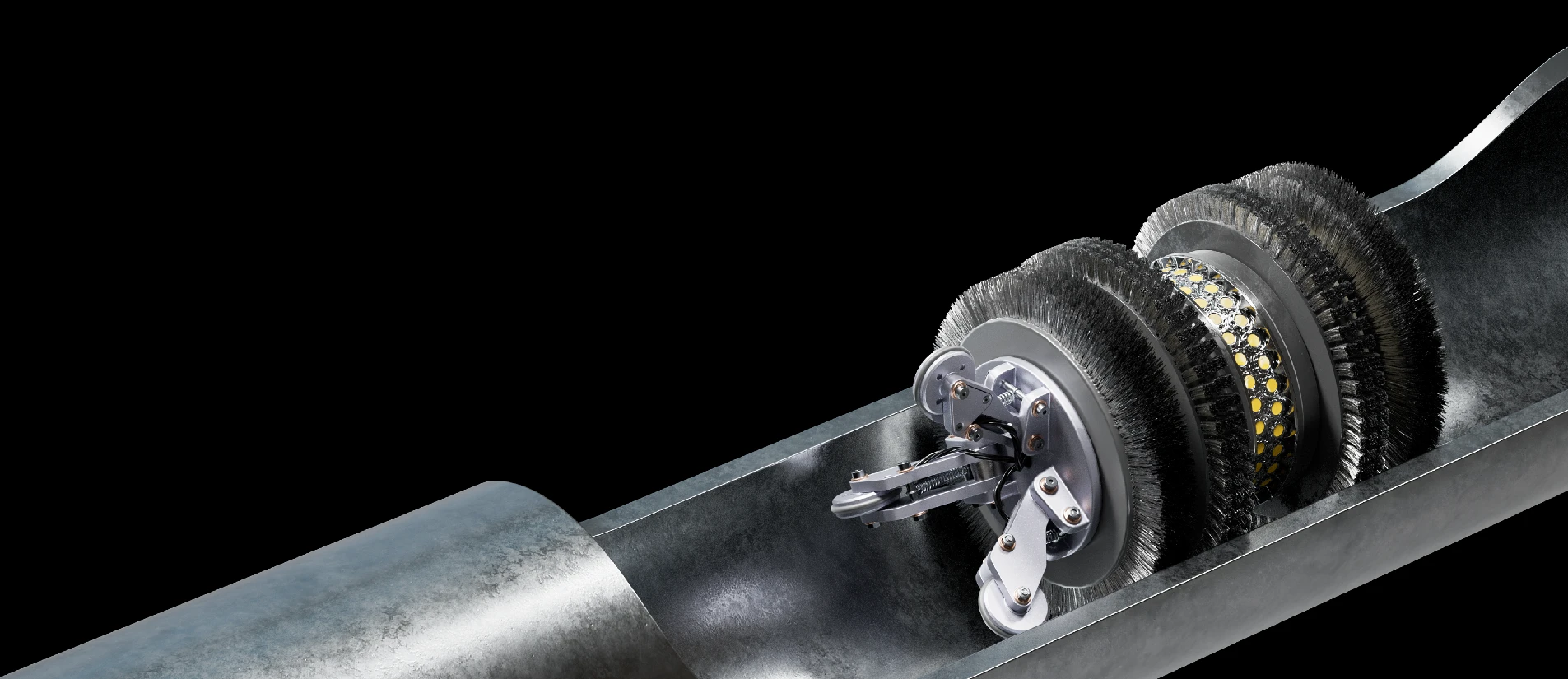
Based on more than 20 years of continuous development, Cokebusters’ patented single-module intelligent pig is a compact, battery-powered, bi-directional inspection tool. Transducers, control electronics, power supply and alignment appendages are all built into one assembly, so it can navigate tight bends, diameter transitions and restricted access points that defeat conventional tools.
Find out more about our in-line inspection service for pipelines and the UT AXIS smart pig.
Using pulse-echo ultrasonic inspection, the intelligent pig gathers high-density internal radius and wall thickness measurements. It can identify and quantify:
Data can be presented numerically, graphically and as C-scan visualisations.
The UT AXIS smart pig adds an integrated odometer to the single-bodied tool. Spring-loaded arms with rubber-tread wheels and triple cross-verification logic log axial position continuously, so every ultrasonic reading is tied to a specific physical location on the pipeline. That turns inspection data into a position-referenced integrity map, making it faster to pinpoint defects, target excavation or maintenance, and compare results over time.
The odometer-equipped smart pig has been deployed on complex, multi-phase carbon steel pipelines with no conventional launcher or receiver, delivering a continuous axial log and a complete ultrasonic dataset despite challenging bends, tees and changes in elevation.
Pipeline inspection is often delivered as part of an integrated programme. Combining mechanical pipeline cleaning with in-line inspection means a pipeline can be cleaned, inspected and verified in a single coordinated operation, with mechanical cleaning operators and inspection technicians working together on site. Inspection data confirms bore condition and validates how effective the cleaning has been. Learn more about cleanliness verification.
Inspection results feed directly into fitness for service and remaining life assessments in accordance with API 579 / ASME FFS-1, as well as digital integrity databases and risk-based inspection programmes. Data is interpreted using Roxtail™ and can be explored in 3D with InsightVision Enterprise.
A pipeline that cannot be inspected with conventional multi-bodied in-line inspection tools, usually because of diameter or schedule changes, tight bends, branches and tie-ins, short lengths, no launch and receive facilities, or poor economics.
In many cases, yes. Cokebusters’ compact single-bodied intelligent pig can be deployed through existing access points and in-line pig valves, with minimal or no modification to the pipeline.
Cokebusters inspects pipelines ranging from 2.5″ to 12″ internal diameter.
Internal and external wall loss, fretting, creep deformation, internal fouling such as coke or scale, pitting corrosion, historic repairs, schedule changes, dents and other geometric anomalies.
The UT AXIS smart pig has an integrated odometer that continuously logs axial position, so every ultrasonic reading is linked to a precise location on the asset.
If you have pipelines or process tubing that have been left out of your inspection regime, we would welcome the chance to assess whether they still need to be. Contact our team to find out more.